Clean Label and Long Lasting Performance Are No Longer a Trade-off in Home Fragrance
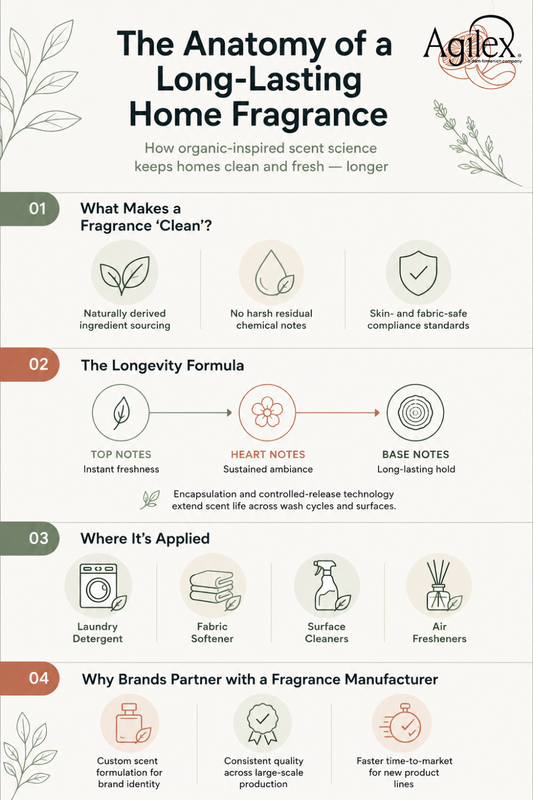
For a long time, brands assumed they had to choose one or the other, a clean, naturally positioned fragrance that faded quickly, or a synthetic-heavy fragrance that lasted for hours but carried ingredients increasingly out of step with what customers wanted to see on a label. That trade-off is no longer as fixed as it used to be, and understanding why matters for any brand trying to compete on both fronts at once.
Why the trade-off existed in the first place
Traditional long-lasting fragrance relied heavily on synthetic fixatives, ingredients specifically engineered to slow the evaporation of lighter fragrance molecules and anchor scent over time. Many of the most effective and reliable fixatives historically came from synthetic chemistry, phthalates being the most well known example, because they were cheap, stable, and highly effective at their job.
As phthalates and similar ingredients came under increasing scrutiny for safety and environmental reasons, brands moving toward clean formulations often lost access to the very tools that gave their fragrances staying power, which is why early clean fragrance products earned a reputation for fading fast.
What has changed
Fragrance chemistry has moved forward considerably. Formulators now have access to a wider range of naturally derived fixatives, certain resins, waxes, and botanical extracts, that can anchor scent nearly as effectively as their synthetic predecessors when used skillfully. Microencapsulation technology, which physically traps fragrance oil in tiny shells that release gradually, has also matured to the point where it can be used with naturally derived fragrance oils, not just synthetic ones, extending longevity without requiring a synthetic fixative at all.
Better understanding of how top, middle, and base notes interact has also allowed formulators to build genuine longevity into a fragrance's structure itself, rather than relying entirely on fixative chemistry to compensate for a poorly balanced formula.
What this means practically for brands
Brands no longer have to accept a straightforward trade-off between a clean formulation and genuine staying power, but achieving both simultaneously still requires real formulation skill. It is not something that happens by simply swapping ingredients in an existing formula. It requires:
Careful selection of naturally derived fixative alternatives suited to the specific application
Thoughtful note structuring that builds longevity into the fragrance architecture itself
Testing with the same rigor traditionally applied to synthetic-heavy formulations, not less
Why this matters competitively
As more customers actively seek out clean-positioned home fragrance products, brands that can also deliver genuine longevity have a real competitive edge over both traditional synthetic-heavy competitors and clean-label competitors still struggling with fast fade. This combination is becoming a genuine market differentiator rather than a nice-to-have.
Getting there requires the right formulation partner
Achieving both clean positioning and long-lasting performance in the same product requires a manufacturer with genuine expertise in modern fixative alternatives and encapsulation technology, not just a willingness to remove ingredients from a formula and hope for the best.
Agilex Fragrances formulates home fragrances that achieve both clean-label positioning and genuine long-lasting performance, using modern fixative strategies and encapsulation approaches suited to each application format. More information is available at Agilex's home care fragrance page.
The old trade-off between clean and long-lasting is fading, much like the fragrances that used to define it. Brands that move on this now, with the right formulation partner, have a real opportunity to lead rather than follow in a category that is only getting more competitive.
Comments
No comments yet. Be the first to comment!